
Guide: Document Parsing + Credit Report
Document Engine API - Getting Started Guide
This guide walks you through the complete process of using the Prestatech Document Engine API to upload, validate, and parse documents, then trigger a credit risk report.
Prerequisites
Before starting, you'll need:
- Access to the API Portal at https://api-portal.prestatech.com/
- A set up user account and active subscription. Consult with us, if you think you don't have any.
- Your subscription credentials (client_id, client_secret, subscription_key)
- OpenAPI specification for the Document Engine API
API Base URL
All API requests are made to: https://api.prestatech.com
📥 Prefer Postman? Download the client Postman collection — import it, set the collection's credential variables, and every endpoint in this guide is ready to run.
Overview
Everything is organised around a process — a container for one application or case. You upload documents into it, the platform parses them asynchronously and notifies you per file, and once the process holds the right inputs you can optionally run a Plend credit risk report over it.
Steps 1–5 cover document parsing and stand on their own: if you only need parsed documents, stop after Step 5. Steps 6–10 add the credit risk report on top of the same process, and Step 11 closes the case.
The flow is:
- Authenticate (Step 1).
- Create a process to hold the case (Step 2).
- Upload a file (Step 3) — parsing starts automatically, or on your explicit trigger.
- Learn when parsing finished (Step 4) — via the "Doc Engine" webhook, or by reading the file by id.
- Upload any additional files, repeating Steps 3–4 per file (Step 5).
- Upload and parse bank statements, the input the report is built on (Step 6).
- Validate the report inputs before committing (Step 7).
- Trigger the report (Step 8) — returns immediately with a
credit_report_id; the result arrives asynchronously. - Receive the result (Step 9) — via the "Workflow" webhook, or by fetching it by id.
- Download the rendered PDF (Step 10).
- Archive the process once the case is closed (Step 11).
Sequence at a glance
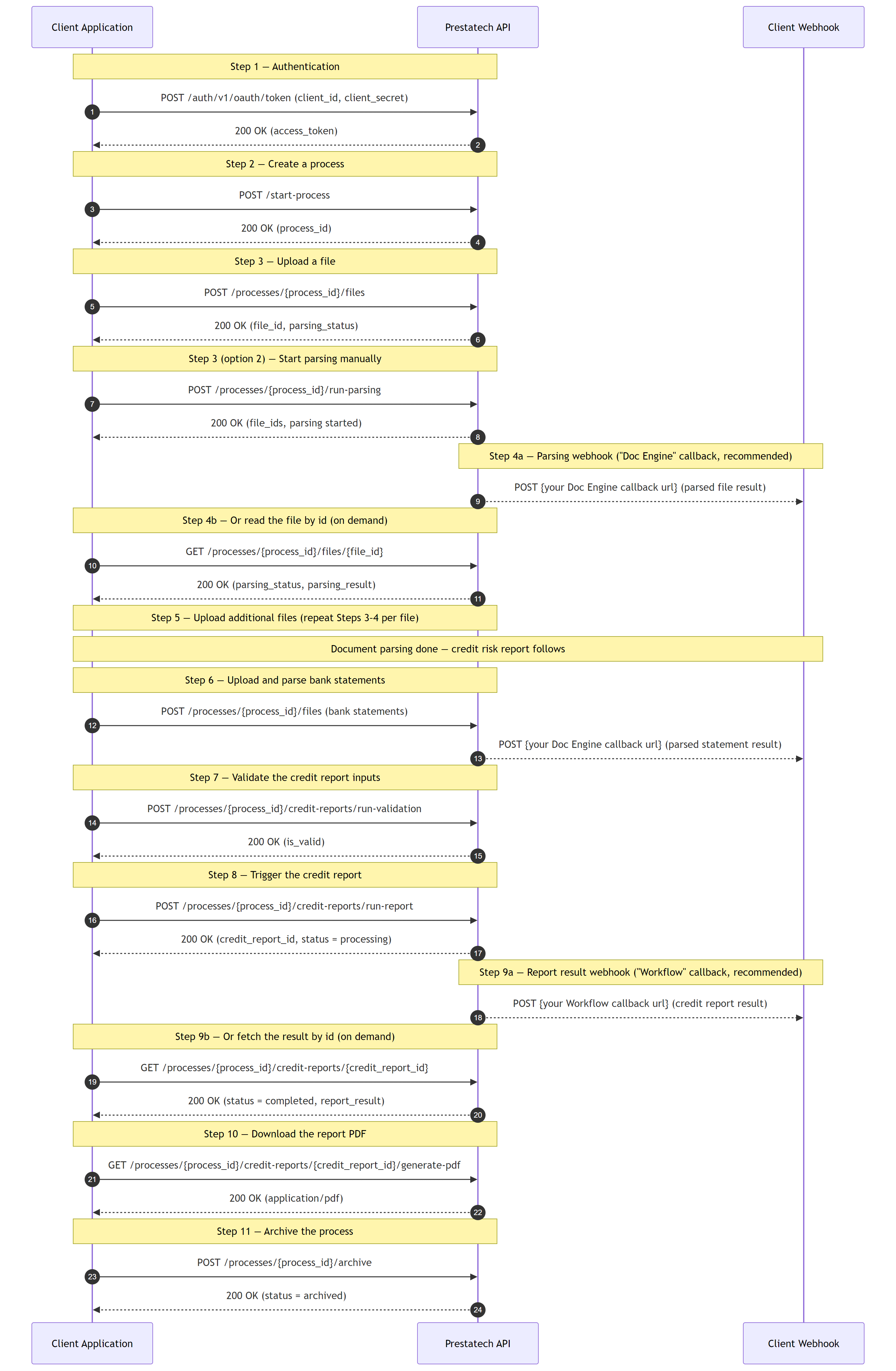
Diagram source (Mermaid)
sequenceDiagram
    autonumber
    participant C as Client Application
    participant API as Prestatech API
    participant WH as Client Webhook

    Note over C,API: Step 1 — Authentication
    C->>API: POST /auth/v1/oauth/token (client_id, client_secret)
    API-->>C: 200 OK (access_token)

    Note over C,API: Step 2 — Create a process
    C->>API: POST /start-process
    API-->>C: 200 OK (process_id)

    Note over C,API: Step 3 — Upload a file
    C->>API: POST /processes/{process_id}/files
    API-->>C: 200 OK (file_id, parsing_status)

    Note over C,API: Step 3 (option 2) — Start parsing manually
    C->>API: POST /processes/{process_id}/run-parsing
    API-->>C: 200 OK (file_ids, parsing started)

    Note over API,WH: Step 4a — Parsing webhook ("Doc Engine" callback, recommended)
    API-->>WH: POST {your Doc Engine callback url} (parsed file result)

    Note over C,API: Step 4b — Or read the file by id (on demand)
    C->>API: GET /processes/{process_id}/files/{file_id}
    API-->>C: 200 OK (parsing_status, parsing_result)

    Note over C,API: Step 5 — Upload additional files (repeat Steps 3–4 per file)

    Note over C,WH: Document parsing done — credit risk report follows

    Note over C,API: Step 6 — Upload and parse bank statements
    C->>API: POST /processes/{process_id}/files (bank statements)
    API-->>WH: POST {your Doc Engine callback url} (parsed statement result)

    Note over C,API: Step 7 — Validate the credit report inputs
    C->>API: POST /processes/{process_id}/credit-reports/run-validation
    API-->>C: 200 OK (is_valid)

    Note over C,API: Step 8 — Trigger the credit report
    C->>API: POST /processes/{process_id}/credit-reports/run-report
    API-->>C: 200 OK (credit_report_id, status = processing)

    Note over API,WH: Step 9a — Report result webhook ("Workflow" callback, recommended)
    API-->>WH: POST {your Workflow callback url} (credit report result)

    Note over C,API: Step 9b — Or fetch the result by id (on demand)
    C->>API: GET /processes/{process_id}/credit-reports/{credit_report_id}
    API-->>C: 200 OK (status = completed, report_result)

    Note over C,API: Step 10 — Download the report PDF
    C->>API: GET /processes/{process_id}/credit-reports/{credit_report_id}/generate-pdf
    API-->>C: 200 OK (application/pdf)

    Note over C,API: Step 11 — Archive the process
    C->>API: POST /processes/{process_id}/archive
    API-->>C: 200 OK (status = archived)
Step 1: Authentication
Get Access Token
First, obtain an access token using your client credentials from the "Subscription" section in the API portal.
Request:
curl -X POST "https://api.prestatech.com/auth/v1/oauth/token" \
  -H "Content-Type: application/json" \
  -H "Ocp-Apim-Subscription-Key: YOUR_SUBSCRIPTION_KEY" \
  -d '{
    "client_id": "your-client-id",
    "client_secret": "your-client-secret"
  }'
Response:
{
  "access_token": "eyJhbGciOiJIUzI1NiIsInR5cCI6IkpXVCJ9...",
  "refresh_token": null,
  "scope": "manage:live-prestatechopenapi manage:live",
  "expires_in": 86400,
  "token_type": "Bearer"
}
Save the access_token - you'll need it for all subsequent API calls.
Step 2: Create a Process
A process serves as a logical container for files related to a single application or case. This helps distinguish between different applications.
Process Management
Beyond creating new processes, you can also:
- List processes (paginated): Use
GET /document-engine/v1/processesfor a paginated list. Optional filters:ext_application_id,space_ids,statuses,created_at_from/created_at_to, pluslimit/offset. Results are ordered bycreated_atdescending. - Get specific process: Use
GET /document-engine/v1/processes/{process_id}to retrieve a single process by its ID - Navigate a process and its sub-entities: A process is a container for several kinds of sub-entity — files, bank accounts, Open Banking accounts and credit reports. The process model summarizes each kind in two ways: a total count (
total_files,total_bank_accounts,total_open_banking_accounts,total_credit_reports) and a preview of the ten most recent items in the corresponding*_refsarray (file_refs,bank_account_refs,open_banking_account_refs,credit_report_refs). The previews are a convenience, not the full set — to page through all items of a kind, call that sub-entity's own paginated list endpoint scoped to the process. For example, for files:GET /document-engine/v1/processes/{process_id}/files?limit=20&offset=0. The other kinds follow the same pattern (/bank-accounts,/open-banking-accounts,/credit-reports).
Create a New Process
Request:
curl -X POST "https://api.prestatech.com/document-engine/v1/start-process" \
  -H "Content-Type: application/json" \
  -H "Authorization: Bearer YOUR_ACCESS_TOKEN" \
  -H "Ocp-Apim-Subscription-Key: YOUR_SUBSCRIPTION_KEY" \
  -d '{
    "ext_application_id": "app-12345",
    "options": {
      "ext_user_id": "user-67890",
      "applicant_type": "employee"
    },
    "attributes": {
      "main_applicant_name": "Mario Rossi",
      "main_tax_code": "RSSMRA80A01H501Z"
    }
  }'
attributes is optional. main_applicant_name and main_tax_code are engine-meaningful applicant attributes — useful to set up front because credit reports can fall back to them.
Response:
{
  "process_id": "0335e8c5-aab7-4391-85b1-e4c4f99dd1a0",
  "ext_application_id": "app-12345",
  "space_id": "default",
  "status": "active",
  "created_at": "2024-06-01T12:00:00Z",
  "updated_at": "2024-06-01T12:00:00Z",
  "total_files": 0,
  "total_bank_accounts": 0,
  "total_open_banking_accounts": 0,
  "total_credit_reports": 0,
  "file_refs": [],
  "bank_account_refs": [],
  "open_banking_account_refs": [],
  "credit_report_refs": [],
  "options": {
    "ext_user_id": "user-67890",
    "applicant_type": "employee"
  },
  "attributes": {
    "main_applicant_name": "Mario Rossi",
    "main_tax_code": "RSSMRA80A01H501Z",
    "source": "api"
  }
}
The total_* fields are unbounded counts; the *_refs arrays are a preview of the ten most recent items of each kind (use the dedicated list endpoints for the full paginated lists — see "Navigate a process and its sub-entities" above).
Save the process_id - you'll use it to upload documents and trigger reports.
Step 3: Upload a File
Upload a file to the process. The API will automatically validate the file and may trigger parsing depending on your tenant configuration.
This step only uploads and validates the file. The parsing_result field will remain null until parsing is completed (see parsing options below). However, for identification documents, we provide a pre_result field with basic parsed data immediately after validation for quick verification purposes.
Note on document_type: This field is optional. If you omit it, the API automatically detects the document type during validation. Supply it only when you want the API to assert that the detected type matches what you expect — if the uploaded file doesn't match the document_type you passed, validation reports a failure instead of silently proceeding. The accepted values are listed in the DocumentType schema of the OpenAPI specification. (A residence permit is used as the example here.)
⚠️ Upcoming document-type rename — read before hardcoding any
document_typevalue. Today many document types carry a country prefix (e.g.it.residency_permit,it.bank_statement) — these are the values shown throughout this guide and accepted by the API now. We are migrating document types to an open, un-prefixed catalog, after which the canonical keys drop the prefix (e.g.bank_statement). During the transition the API will accept both the prefixed and un-prefixed forms and may echo back either, so:
- Do not hardcode an exact-string equality check on a value like
it.bank_statement; match on the suffix (the part after the last.) or treat the value as opaque.- Be prepared to send and receive the un-prefixed form once the migration lands. This applies to every document type.
Request:
curl -X POST "https://api.prestatech.com/document-engine/v1/processes/0335e8c5-aab7-4391-85b1-e4c4f99dd1a0/files" \
  -H "Authorization: Bearer YOUR_ACCESS_TOKEN" \
  -H "Ocp-Apim-Subscription-Key: YOUR_SUBSCRIPTION_KEY" \
  -F "ext_file_id=residence-permit-001" \
  -F "file=@/path/to/residence_permit.pdf"
Response:
{
  "process_id": "0335e8c5-aab7-4391-85b1-e4c4f99dd1a0",
  "ext_file_id": "residence-permit-001",
  "file_id": "6f315ea3-268c-4c79-b70b-bf76273058e4",
  "document_type": "it.residency_permit",
  "validation_result": {
    "status": "success",
    "errors": [],
    "pre_result": {
      "full_name": "Mario Rossi",
      "document_number": "AA1234567",
      "validity_start_date": "2020-01-01",
      "expiration_date": "2030-01-01",
      "issuing_authority": "Comune di MILANO",
      "completeness": "both_sides"
    }
  },
  "result_path": "/processes/0335e8c5-aab7-4391-85b1-e4c4f99dd1a0/files/6f315ea3-268c-4c79-b70b-bf76273058e4",
  "parsing_status": "processing",
  "parsing_confidence": null,
  "parsing_result": null,
  "errors": []
}
Understanding Validation Results
- status: one of:
success— a valid document matching the expected typefailure— the document type is not as expected, or other validation errors were detectedmerged— more than one document was detected within a single uploadunreadable— the file quality is too low, or the document is faulty/password-protectedid_doc_incomplete— an ID document is incomplete (e.g. only one side provided when both are expected); an optional check configured per request
- pre_result: Quick extraction of key document fields for validation
- parsing_status: Current parsing state
Parsing Status Values
uploaded: File uploaded successfully, parsing not startedprocessing: Document is being parsed (async operation)completed: Parsing finished successfullyerror: Parsing failed
Parsing Behavior Options
Note on Parsing: Parsing is an asynchronous operation that typically takes from a few seconds to several minutes, depending on the file complexity and system load. The process follows this flow:
- Once parsing is triggered,
parsing_statusis set to"processing" - Once parsing completes successfully, the status changes to
"completed" - If parsing fails, the status becomes
"error" - The
parsing_resultfield is populated only when parsing completes successfully (parsing_status: "completed")
Option 1: Automatic Parsing
When your tenant configuration has automatic parsing enabled:
- Successfully validated files (
status: "success") automatically trigger parsing - Parsing happens asynchronously in the background
- You'll receive
parsing_status: "processing"immediately after upload - Monitor the file status or set up webhooks to get notified when parsing completes
Option 2: Manual Parsing
When automatic parsing is disabled:
- Files are only validated on upload
- You'll receive
parsing_status: "uploaded" - You must manually trigger parsing using the
/run-parsingendpoint
Manual parsing request:
curl -X POST "https://api.prestatech.com/document-engine/v1/processes/0335e8c5-aab7-4391-85b1-e4c4f99dd1a0/run-parsing" \
  -H "Content-Type: application/json" \
  -H "Authorization: Bearer YOUR_ACCESS_TOKEN" \
  -H "Ocp-Apim-Subscription-Key: YOUR_SUBSCRIPTION_KEY" \
  -d '{
    "file_ids_filter": ["6f315ea3-268c-4c79-b70b-bf76273058e4"]
  }'
Note: The file_ids_filter parameter is optional. If not specified or empty (default), the system will automatically parse all files in the process that have:
parsing_status: "uploaded"validation_result.status: "success"
Step 4: Monitor Parsing Progress
The upload response returns no parsing result — parsing runs asynchronously after upload. There are two ways to learn when a file is done: the recommended "Doc Engine" webhook (the system pushes to you), or an on-demand read of the file by id (you pull).
Webhook Method (Recommended)
Configure the "Doc Engine" webhook in the user portal under Integrations → Webhook to receive automatic notifications when parsing completes. This eliminates the need for polling and provides real-time updates.
The webhook fires once per file, not once per batch. To detect that a whole batch has finished, match the incoming callbacks against the file_ids returned by /run-parsing — the batch is complete once every id has reported. (Alternatively, list the process's files with GET /processes/{process_id}/files and treat the batch as done once none are still processing.)
When parsing is finished, the system will send a POST request to your configured callback URL with a payload equivalent to the response from the GET /processes/{process_id}/files/{file_id} endpoint:
Webhook Payload Example:
{
  "process_id": "0335e8c5-aab7-4391-85b1-e4c4f99dd1a0",
  "ext_file_id": "residence-permit-001",
  "file_id": "6f315ea3-268c-4c79-b70b-bf76273058e4",
  "document_type": "it.residency_permit",
  "validation_result": {
    "status": "success",
    "errors": []
  },
  "result_path": "/processes/0335e8c5-aab7-4391-85b1-e4c4f99dd1a0/files/6f315ea3-268c-4c79-b70b-bf76273058e4",
  "parsing_status": "completed",
  "parsing_confidence": 0.95,
  "parsing_result": {
    "expiration_date": {
      "value": "2030-01-01"
    },
    "validity_start_date": {
      "value": "2020-01-01"
    },
    "full_name": {
      "value": "Mario Rossi"
    },
    "date_of_birth": {
      "value": "1985-03-15"
    },
    "place_of_birth": {
      "value": "Roma"
    },
    "citizenship": {
      "value": "Italian"
    },
    "document_conformed": {
      "value": true
    },
    "document_number": {
      "value": "AA1234567"
    },
    "issuing_authority": {
      "value": "Questura di Roma"
    },
    "front_back_completed": {
      "value": true
    }
  },
  "errors": []
}
Reading Status by ID (On-Demand)
You can call GET /processes/{process_id}/files/{file_id} at any time to sync up on a file's parsing status. Use this for on-demand checks or reconciliation — we don't recommend long-polling it to wait for parsing to finish; use the webhook above for that.
Request:
curl -X GET "https://api.prestatech.com/document-engine/v1/processes/0335e8c5-aab7-4391-85b1-e4c4f99dd1a0/files/6f315ea3-268c-4c79-b70b-bf76273058e4" \
  -H "Authorization: Bearer YOUR_ACCESS_TOKEN" \
  -H "Ocp-Apim-Subscription-Key: YOUR_SUBSCRIPTION_KEY"
The response will have the same structure as shown in the webhook payload example above.
Step 5: Upload Additional Files
You can upload multiple files to the same process. Each document type provides different extracted information.
Check process status:
curl -X GET "https://api.prestatech.com/document-engine/v1/processes/0335e8c5-aab7-4391-85b1-e4c4f99dd1a0" \
  -H "Authorization: Bearer YOUR_ACCESS_TOKEN" \
  -H "Ocp-Apim-Subscription-Key: YOUR_SUBSCRIPTION_KEY"
Response:
{
  "process_id": "0335e8c5-aab7-4391-85b1-e4c4f99dd1a0",
  "ext_application_id": "app-12345",
  "space_id": "default",
  "status": "active",
  "created_at": "2024-06-01T12:00:00Z",
  "updated_at": "2024-06-01T12:05:00Z",
  "total_files": 1,
  "total_bank_accounts": 0,
  "total_open_banking_accounts": 0,
  "total_credit_reports": 0,
  "file_refs": [
    {
      "file_id": "6f315ea3-268c-4c79-b70b-bf76273058e4",
      "ext_file_id": "residence-permit-001",
      "validation_status": "success",
      "parsing_status": "completed",
      "document_type": "it.residency_permit",
      "created_at": "2024-06-01T12:01:00Z",
      "updated_at": "2024-06-01T12:05:00Z"
    }
  ],
  "bank_account_refs": [],
  "open_banking_account_refs": [],
  "credit_report_refs": [],
  "options": {
    "ext_user_id": "user-67890",
    "applicant_type": "employee"
  },
  "attributes": {
    "main_applicant_name": "Mario Rossi",
    "main_tax_code": "RSSMRA80A01H501Z",
    "source": "api"
  }
}
Note:
file_refs(and the other*_refs) are a preview of the ten most recent items only. Thetotal_*fields give the full counts. To page through all files, useGET /processes/{process_id}/files(returns a paginatedFileReflist ordered bycreated_atdescending).
Managing files
You can access file information in multiple ways:
- Individual file details: Use
GET /processes/{process_id}/files/{file_id}to get complete information about a specific file, including parsing results - List all files in a process: Use
GET /processes/{process_id}to retrieve the process model, which includes afile_refsarray containing basic information about all files in the process
Triggering a Credit Risk Report over Bank Statements
So far the steps above cover uploading and parsing individual documents. The credit risk report is a separate, higher-level outcome built on top of a process that contains parsed bank statements and other supported files — and, optionally, additional bank-account transaction data you supply directly as JSON (POST .../bank-accounts) or connect via Open Banking.
The flow is:
- Upload and parse your bank statement files (Step 6) — same upload mechanics as Step 3.
- Validate the inputs before committing (Step 7).
- Trigger the report (Step 8) — returns immediately with a
credit_report_id; the result arrives asynchronously. - Receive the result (Step 9).
- Download the rendered PDF (Step 10).
⚠️ Upcoming document-type rename — read before hardcoding
it.bank_statement. Today bank statements use the IT-prefixed document typesit.bank_statementandit.bank_account_movements(these are the values shown throughout this section and accepted by the API now). We are migrating document types to an open, un-prefixed catalog, after which the canonical keys becomebank_statementandbank_account_movements(theit.prefix is dropped). During the transition the API will accept both the prefixed and un-prefixed forms and may echo back either, so:
- Do not hardcode an exact-string equality check on
it.bank_statement; match on the suffix (the part after the last.) or treat the value as opaque.- Be prepared to send and receive the un-prefixed form once the migration lands. The same caution applies to every document type, not just bank statements.
Step 6: Upload and Parse Bank Statements
Upload your bank statement files to the process exactly as in Step 3. Then make sure parsing has completed for each file (automatic on upload, or triggered manually via /run-parsing — see Step 3) and monitor it as in Step 4. A credit report can only consume files whose parsing_status is completed.
This section uses bank statements as the running example, but a report can consume any supported parsed file. The simplest way to include everything the process has is include_all_data: true when you validate and run (Step 7) — no need to enumerate file types.
Request:
curl -X POST "https://api.prestatech.com/document-engine/v1/processes/0335e8c5-aab7-4391-85b1-e4c4f99dd1a0/files" \
  -H "Authorization: Bearer YOUR_ACCESS_TOKEN" \
  -H "Ocp-Apim-Subscription-Key: YOUR_SUBSCRIPTION_KEY" \
  -F "ext_file_id=bank-statement-001" \
  -F "file=@/path/to/bank_statement.pdf"
As in Step 3, document_type is optional — the API detects the bank-statement type automatically. Pass it only to assert the detected type (validation will failure if the file isn't the type you claimed). The bank-statement types are it.bank_statement for a standard statement and it.bank_account_movements for a movements/transaction list (see the rename warning above before hardcoding either).
The response and the parsing lifecycle are identical to Steps 3–4. Note the file_id of each uploaded statement — you will reference these IDs when triggering the report.
Step 7: Validate the Credit Report Inputs
Before committing to a full run, call run-validation to surface problems with your selected inputs (account-holder mismatch across files, balance-chain breaks, missing transactions, statement-continuity gaps). This does not create a report — it just tells you whether the inputs are good enough to run one.
Provide the inputs you intend to use:
include_all_data— set totrueto include all of the process's report-suitable data: every already-parsed supported file (unparsed/in-progress files are not included) plus all bank accounts and open-banking accounts. The three id arrays below are then ignored. Defaults tofalse.file_ids— IDs of the parsed bank-statement (or other supported) files from Step 6 (already-parsed files only). Empty/omitted selects no files.bank_account_ids— IDs of bank-account transaction data you supplied directly as JSON viaPOST /processes/{process_id}/bank-accounts. Empty/omitted selects no bank accounts.open_banking_account_ids— IDs of accounts connected via Open Banking. Empty/omitted selects no open-banking accounts.report_params—account_holder(must match a holder found in the selected data),data_market(e.g.it,de),data_source(retailorcommercial), and optionaltax_code,loan_period,requested_loan_amount,overdraft_limit.
Choosing inputs: either set
include_all_data: trueto use everything the process has, or leave itfalseand list exactly the ids you want — an empty/omitted array selects none of that kind. This lets you pick anything from zero inputs up to all of them, explicitly.
Request:
curl -X POST "https://api.prestatech.com/document-engine/v1/processes/0335e8c5-aab7-4391-85b1-e4c4f99dd1a0/credit-reports/run-validation" \
  -H "Authorization: Bearer YOUR_ACCESS_TOKEN" \
  -H "Ocp-Apim-Subscription-Key: YOUR_SUBSCRIPTION_KEY" \
  -H "Content-Type: application/json" \
  -d '{
    "include_all_data": true,
    // To pick specific inputs instead, set include_all_data to false and list ids
    // (file_ids covers already-parsed files only):
    // "file_ids": ["6f315ea3-268c-4c79-b70b-bf76273058e4"],
    // "bank_account_ids": [],
    // "open_banking_account_ids": [],
    "report_params": {
      "account_holder": "Mario Rossi",
      "data_market": "it",
      "data_source": "retail",
      "tax_code": "RSSMRA85C15H501Z",
      "loan_period": null,
      "requested_loan_amount": null,
      "overdraft_limit": null
    }
  }'
Response:
{
  "is_valid": true,
  "account_holder_check": {
    "selected_matches_any_from_files": true,
    "acc_holders_from_files_are_same": true,
    "selected_account_holder": "Mario Rossi"
  },
  "data_details": {
    "elems": [
      {
        "id": "6f315ea3-268c-4c79-b70b-bf76273058e4",
        "type": "file",
        "account_holder": "Mario Rossi",
        "normalized_account_holder": "mario rossi",
        "account_holder_mismatch": false,
        "iban": "IT60X0542811101000000123456",
        "has_balance_mismatch": false,
        "is_blocking_report": false
      }
    ]
  }
}
Check is_valid before proceeding. The per-input data_details.elems[].is_blocking_report flag tells you exactly which input would stop the report (e.g. a file with no transactions). The full response also includes detailed balance_mismatch_check / continuity_check blocks — omitted here for brevity; see the CreditReportValidationModel schema in the OpenAPI specification.
Step 8: Trigger the Credit Report
Once validation is satisfactory, call run-report with the same request body as run-validation. The endpoint re-runs validation server-side and, if it passes, creates a credit report artifact in processing status and returns immediately with its credit_report_id. The actual scoring runs asynchronously — the response does not contain the finished report.
Request:
curl -X POST "https://api.prestatech.com/document-engine/v1/processes/0335e8c5-aab7-4391-85b1-e4c4f99dd1a0/credit-reports/run-report" \
  -H "Authorization: Bearer YOUR_ACCESS_TOKEN" \
  -H "Ocp-Apim-Subscription-Key: YOUR_SUBSCRIPTION_KEY" \
  -H "Content-Type: application/json" \
  -d '{
    "include_all_data": true,
    // To pick specific inputs instead, set include_all_data to false and list ids
    // (file_ids covers already-parsed files only):
    // "file_ids": ["6f315ea3-268c-4c79-b70b-bf76273058e4"],
    // "bank_account_ids": [],
    // "open_banking_account_ids": [],
    "report_params": {
      "account_holder": "Mario Rossi",
      "data_market": "it",
      "data_source": "retail",
      "tax_code": "RSSMRA85C15H501Z",
      "loan_period": null,
      "requested_loan_amount": null,
      "overdraft_limit": null
    }
  }'
Response:
{
  "credit_report_id": "9a8b7c6d-5e4f-3a2b-1c0d-9e8f7a6b5c4d",
  "process_id": "0335e8c5-aab7-4391-85b1-e4c4f99dd1a0",
  "created_at": "2024-06-01T12:15:00Z",
  "updated_at": "2024-06-01T12:15:00Z",
  "status": "processing",
  "report_params": {
    "account_holder": "Mario Rossi",
    "data_market": "it",
    "data_source": "retail",
    "tax_code": "RSSMRA85C15H501Z"
  },
  "attributes": {
    "is_monitored": false
  },
  "validation": { "is_valid": true },
  "report_result": null
}
Save the credit_report_id. A 400 here means server-side validation failed (re-run validation as in Step 7 to see which inputs are blocking); the report is not created in that case.
Credit Report Status Values
processing— report triggered, result not yet receivedcompleted— scoring finished successfully;report_resultis populatedterminated— the workflow was terminatederror— scoring failed, or one or more steps errored
Step 9: Receive the Report Result
Scoring is asynchronous (typically seconds to a few minutes). There are two ways to get the finished report.
Webhook Method (Recommended)
Configure the "Workflow" webhook in the user portal under Integrations → Webhook. It delivers credit report results — distinct from the "Doc Engine" webhook that delivers parsed-file results (used in Step 4). Set the "Workflow" webhook URL to receive a POST when a report finishes.
When the report completes, the system POSTs the full credit report (the same shape as GET .../credit-reports/{credit_report_id} — see below) to your configured URL, with status set to completed (or error / terminated on failure).
Fetching by ID (Polling — Not Recommended)
You can always fetch the current state of a report by its ID at any time. Continuous polling is not recommended — prefer the webhook above — but a by-ID fetch is the right call to retrieve the actual result on demand (e.g. after receiving the callback, or to re-read a stored report). Poll only if you cannot receive webhooks, and back off between requests until status is no longer processing:
Request:
curl -X GET "https://api.prestatech.com/document-engine/v1/processes/0335e8c5-aab7-4391-85b1-e4c4f99dd1a0/credit-reports/9a8b7c6d-5e4f-3a2b-1c0d-9e8f7a6b5c4d" \
  -H "Authorization: Bearer YOUR_ACCESS_TOKEN" \
  -H "Ocp-Apim-Subscription-Key: YOUR_SUBSCRIPTION_KEY"
Response (completed):
{
  "credit_report_id": "9a8b7c6d-5e4f-3a2b-1c0d-9e8f7a6b5c4d",
  "process_id": "0335e8c5-aab7-4391-85b1-e4c4f99dd1a0",
  "created_at": "2024-06-01T12:15:00Z",
  "updated_at": "2024-06-01T12:16:30Z",
  "status": "completed",
  "report_params": {
    "account_holder": "Mario Rossi",
    "data_market": "it",
    "data_source": "retail"
  },
  "attributes": { "is_monitored": false },
  "validation": { "is_valid": true },
  "report_result": {
    "srg": { "...": "scoring output block" }
  },
  "used_files": [
    {
      "file_id": "6f315ea3-268c-4c79-b70b-bf76273058e4",
      "ext_file_id": "bank-statement-001",
      "document_type": "it.bank_statement",
      "parsing_status": "completed"
    }
  ],
  "used_bank_accounts": [],
  "used_open_banking_accounts": []
}
You can also list all reports for a process with GET /processes/{process_id}/credit-reports.
Step 10: Download the Report PDF
Once the report's status is completed, render it as a PDF. The langCountryCode query parameter selects the locale (e.g. it, de); if omitted it falls back to the report's data market, then to it.
Request:
curl -X GET "https://api.prestatech.com/document-engine/v1/processes/0335e8c5-aab7-4391-85b1-e4c4f99dd1a0/credit-reports/9a8b7c6d-5e4f-3a2b-1c0d-9e8f7a6b5c4d/generate-pdf?langCountryCode=it" \
  -H "Authorization: Bearer YOUR_ACCESS_TOKEN" \
  -H "Ocp-Apim-Subscription-Key: YOUR_SUBSCRIPTION_KEY" \
  --output credit_report.pdf
The response body is the PDF file (application/pdf). A 400 means the report is not yet completed or its result is missing the required scoring data — wait for completion (Step 9) before requesting the PDF.
Step 11: Archive a Process
Once you have completed processing a case and no longer need to make changes, you can archive the process. Archiving makes a process read-only, preventing any further modifications while preserving all data for retention purposes.
Processes have a status field that indicates their current state:
active: The process can be modified (upload files, run parsing)archived: The process is read-only - you can only read data, no modifications or actions are allowed
Request:
curl -X POST "https://api.prestatech.com/document-engine/v1/processes/0335e8c5-aab7-4391-85b1-e4c4f99dd1a0/archive" \
  -H "Authorization: Bearer YOUR_ACCESS_TOKEN" \
  -H "Ocp-Apim-Subscription-Key: YOUR_SUBSCRIPTION_KEY"
Response:
{
  "process_id": "0335e8c5-aab7-4391-85b1-e4c4f99dd1a0",
  "ext_application_id": "app-12345",
  "status": "archived",
  "created_at": "2024-06-01T12:00:00Z",
  "updated_at": "2024-06-01T13:00:00Z",
  "file_refs": [
    {
      "file_id": "6f315ea3-268c-4c79-b70b-bf76273058e4",
      "ext_file_id": "residence-permit-001",
      "validation_status": "success",
      "parsing_status": "completed",
      "document_type": "it.residency_permit"
    }
  ],
  "options": {
    "ext_user_id": "user-67890",
    "applicant_type": "employee"
  }
}
Misc: Best Practices
- Use meaningful external IDs: Use your own application and file IDs for easier tracking
- Set up webhooks: Avoid polling by configuring callbacks for real-time updates
- Handle async operations: Parsing is asynchronous - design your workflow accordingly
- Check validation before parsing: Only successfully validated files should be parsed
- Monitor quotas: Be aware of your parsing quotas and limits
- Error handling: Implement proper error handling for all API calls
Next Steps
For detailed API reference, consult the OpenAPI specification.